
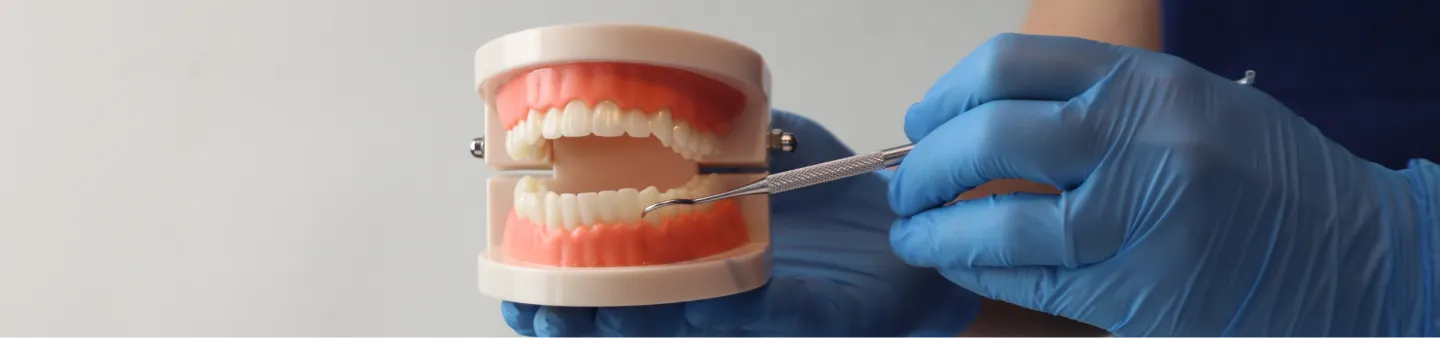
Digital impressions replace messy putty molds with precise 3D scans of your teeth and gums. Digital impressions in North Haledon, New Jersey, help plan and create crowns, bridges, veneers, implants, dentures, night guards, and clear aligner therapy with accuracy and comfort. This page outlines how the technology works, the benefits, and what you can expect at a typical visit.
Digital Impressions Explained
Digital impressions use a handheld intraoral scanner to capture thousands of images per second and stitch them into a lifelike 3D model of your mouth. The scanner’s light-based imaging does not use radiation and records fine surface details, including bite relationships, undercuts, and soft tissue contours. The resulting file is reviewed chairside and shared with a dental lab or in-office design system for computer-aided design and manufacturing.
Compared to traditional impressions, this approach is cleaner, faster, and often more accurate for many treatments. It supports single crowns and onlays, multi-unit bridges, implant restorations, partial and complete dentures, and orthodontic planning for clear aligners. Common search topics like what are digital dental impressions, how do intraoral scanners work, digital vs traditional impressions, and dental restorations all point to the same goal: a better-fitting final result with fewer adjustments.
Benefits of Digital Impressions
Quality care tailored to your needs.
- Greater comfort without trays, gooey materials, or lingering tastes.
- High accuracy that helps reduce remakes and fine-tunes the fit of restorations.
- Less chair time because scans are quick and can be reviewed immediately.
- Improved communication as you and dentist can see the 3D model together.
- Fewer appointment delays because files transmit to the lab within minutes.
- Better experience for sensitive gag reflexes since scanning wands are smaller.
- Eco-friendly workflow that reduces disposable impression waste.
Have Questions? We're Here to Help.
Our team is happy to discuss your options and create a plan tailored to your needs.
How Digital Impressions Work
The process is straightforward and comfortable from start to finish.
- Initial review: The mouth is examined to ensure tissues are healthy enough for scanning.
- Tooth preparation if needed: For a crown or veneer, the tooth is shaped and isolated.
- Scanning: The clinician moves a small wand over your teeth to capture full upper, lower, and bite records.
- On-screen check: The 3D model appears in real time to verify margins, contacts, and detail.
- Secure transfer: The file is sent to the lab system for design and fabrication.
What to Expect
Most scans take a few minutes per arch, and many full-mouth scans finish in about 5–10 minutes. You will see the 3D model on a screen, which helps you understand the plan and discuss options. No radiation is involved because the scanner uses structured light or laser to map surfaces.
Preparation is minimal. Brushing before your appointment helps the scanner read surfaces clearly. Avoid heavy lipsticks or tinted balms that can reflect light onto teeth. If there is bleeding or excess saliva, a brief pause or isolation may be used so the scanner can record clean margins. In some cases, a short rescan of a small area is done to capture extra detail.
Digital impressions are suitable for most people. Certain deep subgingival margins, reflective metals, or active gum inflammation can make any impression method more challenging. In those situations, our dentist may use tissue retraction, drying aids, or a combination of digital and conventional techniques to ensure accuracy.
Frequently Asked Questions About Digital Impressions
Yes. Modern intraoral scanners capture fine details with micrometer-level precision. Accuracy depends on proper isolation, clear margins, and clinical technique.
Often, yes. Many crowns, bridges, aligners, and night guards are scanned digitally. Some complex cases may still benefit from a hybrid approach using both methods.
Most single-arch scans take a few minutes. Full upper, lower, and bite scans commonly finish in 5–10 minutes, depending on the procedure and needed detail.
Yes. Scanners use visible or near-infrared light, not X-rays. The process is noninvasive and comfortable, with no impression materials to trigger gagging.
Yes. Digital files are standard for planning clear aligners and for fabricating crowns, onlays, bridges, and implant restorations.
Digital scanning is typically easier than trays. The wand is compact, scanning is quick, and you can pause as needed to breathe comfortably through your nose. Have questions about digital impressions in North Haledon, NJ, or a specific treatment plan? Contact Parkview Dental & Prosthodontics at 973-423-3399 to schedule with Dr. Sebu Idiculla or Dr. Lori M. Nasif.
Take the Next Step Toward a Healthier Smile
Contact Parkview Dental & Prosthodontics today. Our team looks forward to helping you achieve the smile you deserve.